


Introduction
Are you getting regular laundry orders but still wondering where the money goes? Your laundry pricing may be lower than you think.
Setting the right price is important for covering your operating costs, maintaining service quality and building a sustainable laundry business.
Understanding your actual costs and knowing what your customers value can help you identify whether your current pricing is supporting your business or quietly reducing your profits.
Why Does Laundry Pricing Matter?
Laundry pricing is not only about deciding how much to charge customers. Your price needs to cover the cost of processing an order while leaving enough room for profit and future business growth.
Many laundry businesses consider basic expenses such as detergent and labour but may overlook electricity, water, packaging, transportation, rent, equipment maintenance and other operating costs.
If these costs are not included when setting prices, a business can receive plenty of orders without generating enough profit.
7 Signs You May Be Charging Too Little for Laundry
Not sure whether your current laundry prices need to be reviewed? These are some common signs that your pricing strategy may be affecting your business.
1. You Know Your Selling Price but Not Your Actual Cost
Do you know how much you charge for a wash and fold service but not how much it actually costs you to process that order?
Every laundry service has several costs involved, including labour, electricity, water, detergent, packaging and equipment usage.
Understanding your actual cost can help you determine whether your current price is leaving enough room for profit.
2. You Are Simply Copying Competitor Prices
Checking competitor prices can help you understand the local market, but copying another laundry business's rates may not work for your business.
Different businesses have different rent, staffing, equipment, delivery and operating costs.
Your laundry service pricing should reflect your own costs, service quality and customer offering.
3. You Are Getting Orders but Still Not Making Enough Money
A busy laundry shop is not necessarily a profitable laundry shop.
If your machines are running throughout the day and your team is handling regular orders but very little money remains after paying expenses, your margins may be too low.
Regular orders are valuable, but your pricing also needs to support the long-term health of your business.
4. Customers Always Expect Discounts
Discounts can help attract new customers, but constantly reducing your prices can make it difficult to maintain healthy margins.
If customers regularly ask for lower prices before placing an order, it may be worth reviewing how your services are priced and presented.
Instead of competing only on price, businesses can focus on convenience, service quality, reliability and turnaround time.
5. Pickup and Delivery Costs Are Reducing Your Profit
Pickup and delivery can make laundry services much more convenient for customers, but transportation also creates additional business costs.
Fuel, delivery staff, travel time and inefficient routes can reduce your margin if these expenses are not considered when setting prices.
Reviewing delivery areas and order values can help businesses manage these costs more effectively.
6. Equipment and Maintenance Costs Are Increasing
Washing machines, dryers and other laundry equipment require regular maintenance and occasional repairs or replacement.
If your prices only cover your daily operating expenses, unexpected equipment costs can put additional pressure on your business.
A sustainable laundry business should consider both current and future operating costs when setting prices.
7. You Cannot Reinvest in Your Business
Another warning sign is when your business can continue operating but you cannot invest in improving it.
If there is not enough money available for better equipment, employee training, marketing, technology or customer acquisition, your current pricing may be limiting your growth.
Healthy margins can give a laundry business more flexibility to improve its operations and attract more customers.
What Costs Should a Laundry Business Consider?
Before changing your prices, it is important to understand what it actually costs to provide each service.
Some common laundry business costs include:
- Labour and staff expenses
- Electricity and water
- Detergent and cleaning products
- Packaging materials
- Pickup and delivery expenses
- Rent and other operating costs
- Equipment maintenance
- Repairs and replacement costs
- Marketing and customer acquisition
Knowing these costs can help you understand whether your current laundry prices are sustainable.
Common Laundry Pricing Mistakes to Avoid
Copying Competitor Prices Without Calculating Your Costs
Your competitor's price may look attractive, but their operating costs may be very different from yours.
Offering Discounts Too Frequently
Regular discounts can reduce your margins and may also make customers expect lower prices every time they order.
Ignoring Pickup and Delivery Costs
Transportation costs can add up quickly, especially when orders are small or delivery routes are inefficient.
Forgetting Equipment Maintenance
Machines are an important part of a laundry business. Maintenance and replacement costs should be considered when calculating your pricing.
Focusing Only on Getting More Orders
More orders are useful only when they contribute positively to your business. Increasing order volume without considering profitability can put additional pressure on your operations.
Should You Always Be the Cheapest Laundry Service?
Being the cheapest laundry service in your area may attract customers, but low pricing is not always a sustainable business strategy.
Customers may also consider cleaning quality, garment handling, turnaround time, convenience, reliability and customer service.
A laundry business can compete by providing clear value rather than trying to offer the lowest price for every service.
What Are Customers Actually Paying For?
Customers are not only paying for their clothes to be washed. They are also paying for convenience, reliability and proper garment care.
Depending on the service, customers may value:
- Convenient pickup and delivery
- Reliable turnaround times
- Proper garment handling
- Consistent cleaning quality
- Professional ironing and folding
- Dry cleaning for specialised garments
- Easy booking
- Order tracking
- Responsive customer service
Understanding what customers value can help laundry businesses build pricing around the complete service experience rather than only the cost of washing clothes.
When Should You Review Your Laundry Prices?
Your laundry pricing should not be something you decide once and never revisit.
It may be useful to review your prices when:
- Your electricity or water costs increase.
- Staffing costs increase.
- Transportation expenses become higher.
- Equipment requires frequent repairs.
- Your rent or operating expenses change.
- Your service offering changes.
- You are getting more orders but not seeing better profits.
Regularly reviewing your costs can help you make pricing decisions based on your actual business situation.
How LaunderGo Can Help Laundry Businesses Reach More Customers
Getting your pricing right is one part of running a successful laundry business. Reaching the right customers is another.
LaunderGo connects customers with local laundry service providers through a digital platform, giving laundry businesses an additional potential channel for customer acquisition.
For an existing laundry business, reaching more customers can help increase order opportunities without relying only on walk-in customers or traditional local marketing.
If you run a laundry business and want to explore becoming a LaunderGo partner, you can register as a laundry partner.
Laundry Pricing in India: Why Local Costs Matter
Laundry businesses in India operate in different local markets, which means pricing can vary depending on location, operating costs, customer expectations and competition.
For laundry businesses in Delhi NCR, areas such as Delhi, Noida, Gurugram, Ghaziabad and Faridabad can have different operating conditions and customer requirements.
This is why copying a single laundry price from another business may not always be the right approach.
Understanding your own costs and the value of your service can help you build a pricing strategy that works for your business.
Final Thoughts
Charging too little can be just as damaging to a laundry business as charging too much.
If your business is busy but you are struggling to cover expenses, maintain equipment or reinvest in growth, it may be time to review your pricing.
Start by understanding your actual costs, study your local market and consider the value you provide to customers.
A sustainable laundry business is not necessarily the one with the lowest prices. It is one that can deliver consistent service while covering its costs and creating room for future growth.
If you are looking for another way to reach customers, explore becoming a LaunderGo laundry partner.
Frequently Asked Questions
Related articles

Is Your Washing Machine Ruining Your Clothes? 10 Mistakes You Might Be Making
Is your washing machine damaging your clothes? Learn about 10 common laundry mistakes that can cause fading, shrinking, stretching, holes and fabric damage, and how to protect your clothes while washing.
Sep 25, 2026
Laundry Pickup and Delivery: A Simple Guide to Hassle-Free Laundry
Discover how laundry pickup and delivery services can save time, simplify your routine, and keep your clothes fresh and professionally cleaned.
Sep 22, 2026
Got a Laundry Shop but Still Not Getting Enough Orders? Here’s What You’re Missing
Running a laundry shop but still struggling to get enough orders? Discover why good laundry businesses often remain dependent on walk-ins and referrals, and how digital customer access can help laundry owners find new opportunities and grow their business.
Sep 19, 2026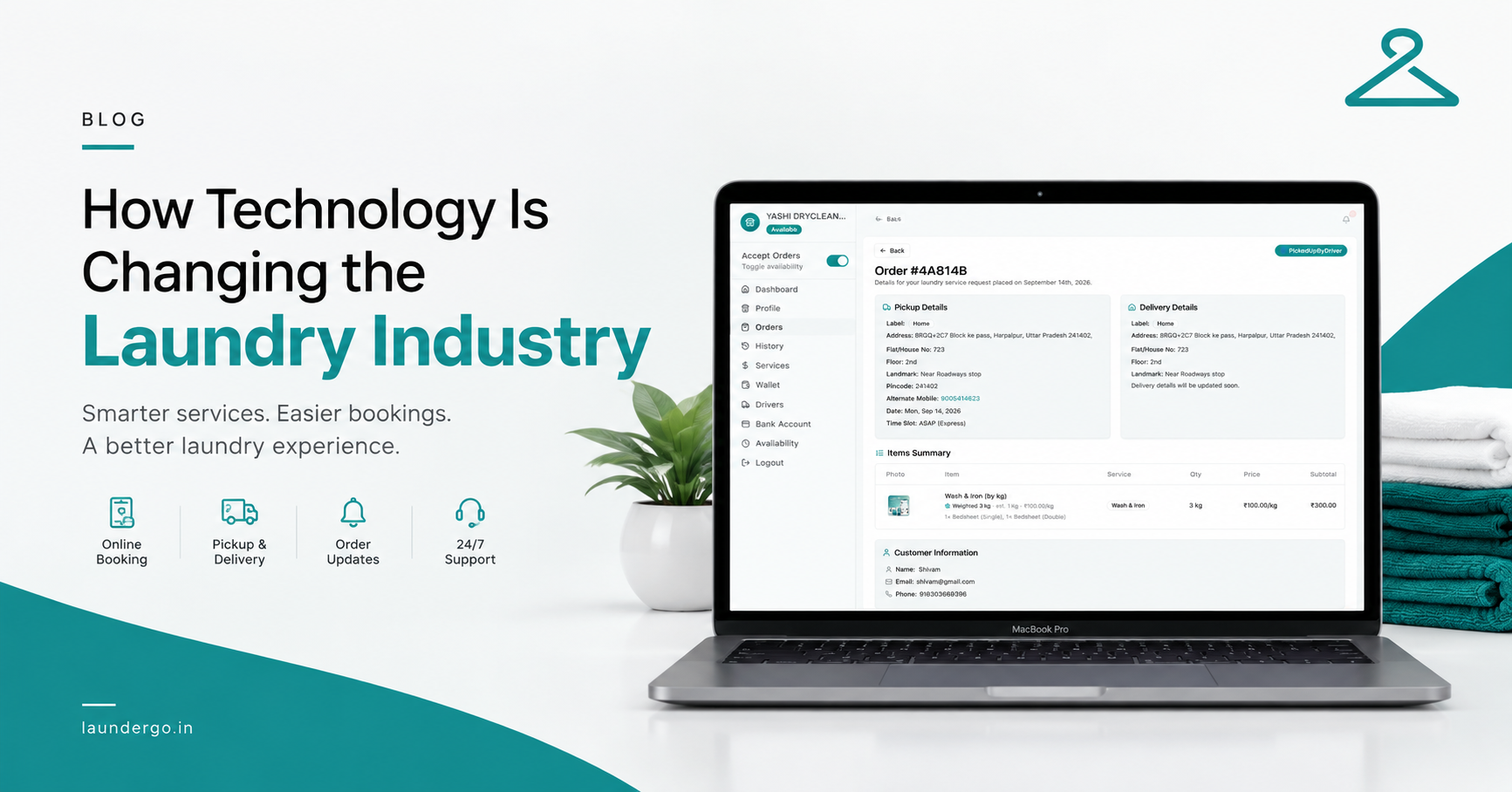
Smart Laundry Technology: How Digital Platforms Are Changing Laundry Services in India
Discover how smart laundry technology, digital booking, order management, pickup and delivery systems, and online service platforms are transforming laundry services in India and making professional clothing care more convenient.
Sep 14, 2026